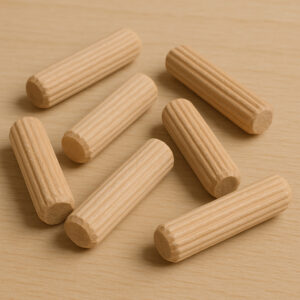
We manufacture our wooden cabby dowels or dowel pins from quality materials.
Cabby dowels are used in the construction of cabinets and furniture to strengthen and stabilise furniture joints. They are also referred to as cabinet maker dowels, dowel pins, wood connector pins, tenon pins or dowel joiner pins.
Our cabinetmakers dowels or wooden pins are produced in two styles, smooth or grooved (fluted).
These wooden dowel pins are suitable for use in a variety of craft projects such as kite making, doll houses, puppetry, wooden toys, model makers and even musical instruments.
Sizes range from 8 to 15mm.
No order too small.
Dowel Australia provides pre-cut cabinet makers dowels to make life easier for the do-it-yourselfer or the professional. Generally, the dowels are one inch in length. They have rounded ‘bullet’ tops and very often have fluted edges to allow glue to settle in and take hold to strengthen joins.
You can purchase cabinet makers dowels in bulk packages, or in smaller amounts for single or small projects. They’re made in a wide variety of woods, though the most common are hardwoods, which withstand far more wear than soft woods such as pine.
Contact us:
Phone: 0433 695 045
Assembling Furniture Using Cabinet Makers Dowels
Throughout the ages, cabinet makers and furniture makers have used various methods to assemble furniture. Better quality furniture, even now, is assembled using all wood joints, including mortise and tenon, dovetail and chamfered wooden pegs. Since the 1850s, the most common type of furniture assembly used wooden cabinet makers dowels as pegs to hold the finished piece together securely.
Assembling furniture using wooden cabinet makers dowels requires careful measuring and precise cutting and assembly. To assemble a piece of furniture using wooden cabinet makers pegs, the cabinet maker first drills holes into the pieces to be assembled. The holes must be precisely placed in each piece to be joined so that the finished piece of furniture fits together properly. He then cuts a wooden dowel of the correct diameter into one inch slices, and carefully whittles them to the right size to fit snugly into the holes. The pegs – now whittled into cabinet makers dowels – are generally fitted halfway into every other hole on each piece to be joined. Finally, the two pieces are lined up so that the pegs on one side align with the holes in the other and firmly pressed together. A cushioned mallet may be used to pound the pieces together. If the fit is correct, the joint will serve for decades and longer – without glue.